


The Riseley Curriculum
Curriculum Overview
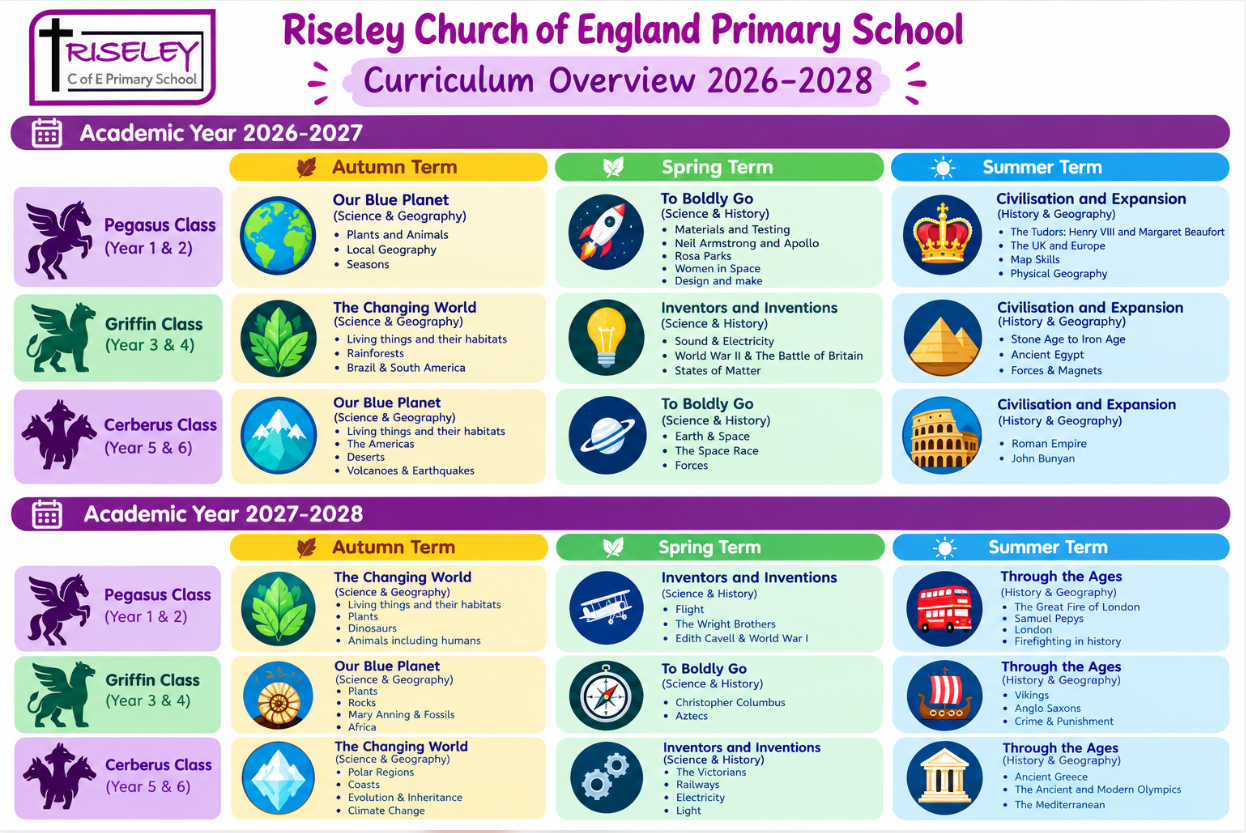
The curriculum at Riseley Church of England Primary School has been designed to ensure that all children who attend the school can 'flourish fully through life and learning'. A new curriculum model was implemented in September 2022 following a review by the partnership curriculum leader and Executive Headteacher.
The model uses a mixture of thematic and standalone teaching to provide a broad curriculum for our children.
History, Geography and Science are delivered through our six main topics. English and Maths are taught each day, but connections are made to the topics through the texts studied and where possible with Maths. Connections are also made through Art and DT on occasion.
Religious Education, French, Computing, Physical Education, PSHE and Music are all taught as standalone subjects.
Curriculum Intent
The key question 'why do we do what we do?' is fundamental to our curriculum. All staff agree that our new curriculum meets the following criteria:
-
it caters for the needs of all our children; not just their academic needs, but their 'lifelong learning' needs as well;
-
it inspires our children to have the highest expectations of themselves;
-
it promotes a love of learning in all our children;
-
it promotes outdoor learning to develop our children's understanding of nature, respect for the environment and the impact of humanity on the world in which they live;
-
it prepares children for the next stage of their educational journey;
-
it provides our children with a variety of life experiences including sport, art, music and technology;
-
it provides opportunities for positive parental engagement and collaboration.
-
it promotes our school vision where every child can meet their full potential in an inclusive, nurturing and caring learning environment.
-
it provides all the opportunities that our children need to flourish.
Our curriculum is designed to ensure that all of our children meet their full potential spiritually, morally, emotionally, socially, culturally and physically and not just academically. Our curriculum is designed to promote a love of learning, collaborative learning and most importantly, develop the foundations for our children to become resilient, confident and creative adults.
Curriculum Implementation
In the past, each year group or key stage has learnt a series of topics in isolation from other year groups or key stages. This has reduced opportunities for 'whole school' learning or collaboration across different year groups or key stages.
Topics were changed each half-term, which often resulted in the teacher rushing to finish the topic before the end of the term and severely limiting opportunities for 'exploring with freedom' in the classroom. Teachers were not able to delve deeper into a topic or an event when opportunities arose because of time constraints.
The curriculum consists of 6 topics which will revolve on a two-year cycle, which means that children will revisit each topic and build on their prior knowledge:
-
Our Blue Planet (Science & Geography)
-
To Boldly Go (History & Science)
-
Civilisation & Expansion (History & Geography)
-
The Changing World (Science & Geography)
-
Inventors and Inventions (History & Science)
-
Through Ages Past (History & Geography)
Each year, a week is dedicated in the summer term to a science and sports week to cover aspects of the Science curriculum that can't be taught as part of our main topics.
Curriculum Impact
Whilst pupil outcomes will always be a quantifiable measure of accountability in schools and a method by which school curriculums are assessed, the fact remains that education is about more than a set of figures or a spreadsheet full of data. The impact of a curriculum and its methodology should be more focused on other factors which in our view are as equally important to test scores and teacher assessments. In fact, our curriculum has been designed to ensure that its impact is seen in other ways rather than just through data.
The curriculum’s impact will be measured by considering the following questions:
-
Do our children feel more confident in their abilities and do they feel more able to try something new?
-
Do our children demonstrate increased resilience in challenging circumstances?
-
Can our children demonstrate an increased ability to work well as part of a group to solve problems?
-
Can our children demonstrate an increased ability to resolve conflicts by themselves in a mature manner?
-
Do our children demonstrate an increased ability to work independently when required?
-
Do our children demonstrate an increased curiosity in their learning?
-
Can our children recognise these qualities in themselves and others?
-
Do our children demonstrate a love for learning?
-
Do our children demonstrate higher aspirations for themselves?
