


Forest School
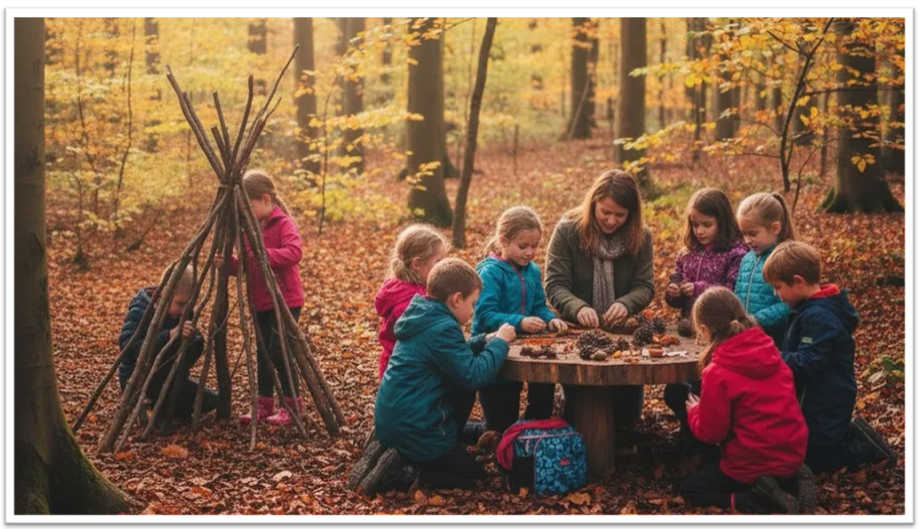
Forest School and its relevance to primary schools
Forest school is a long-term, learner-centred approach to education that takes place in a woodland or other natural setting. Children visit the same outdoor site regularly, ideally weekly, across a full school year or more, in all seasons and most weathers. The approach grew from Scandinavian outdoor traditions and was developed in the UK in the 1990s. Today it is overseen by the Forest School Association (FSA), which sets out six guiding principles:
-
It is a long-term process. It is a series of regular sessions rather than a one-off trip, so children build familiarity with the place and with each other.
-
It takes place in a woodland or natural environment. This supports a relationship between the learner and the natural world.
-
It promotes holistic development. It aims to nurture the whole child: emotional, social, physical, cognitive and spiritual.
-
It offers learners the chance to take supported risks. The risks are appropriate to the environment and to the individual.
-
It is run by qualified forest school practitioners who continuously develop their professional practice.
-
It is learner-centred. Children’s interests, choices and ideas shape the sessions, and practitioners facilitate rather than direct.
A forest school is not simply a lesson moved outdoors, nor a nature walk or a one-day activity. What makes it distinct is the pedagogy: children have sustained time, genuine choice, and a trusted adult who observes and responds rather than leading from the front.
What does a typical forest school session look like?
A typical session lasts between one and three hours. It usually begins with a routine such as a short walk to the site, a group circle, or a reminder of the boundaries and safety agreements. Children then spend most of the time in self-directed or small-group activity. This might include:
-
Building dens and shelters
-
Making mud kitchens
-
Climbing, balancing and rolling
-
Using real tools with training (hand saws, bow saws, potato peelers for whittling, mallets)
-
Learning to light and tend a fire under close supervision
-
Cooking simply on the fire
-
Making natural art
-
Tracking and identifying wildlife
-
Telling stories and playing games
Sessions often close with a reflective circle in which children share what they did and learnt. Practitioners carry out risk-benefit assessments rather than simply removing hazards, and they teach children to assess risk themselves. Staff-to-child ratios are generally higher than in the classroom, and groups are often small.
Progress is gradual. A class might begin by learning boundaries and site rules, move on to simple tool use once trust and competence are established, and eventually take on more complex projects. Learning is observed and recorded through notes, photographs and conversation rather than through tests.
Why is it relevant for our primary school?
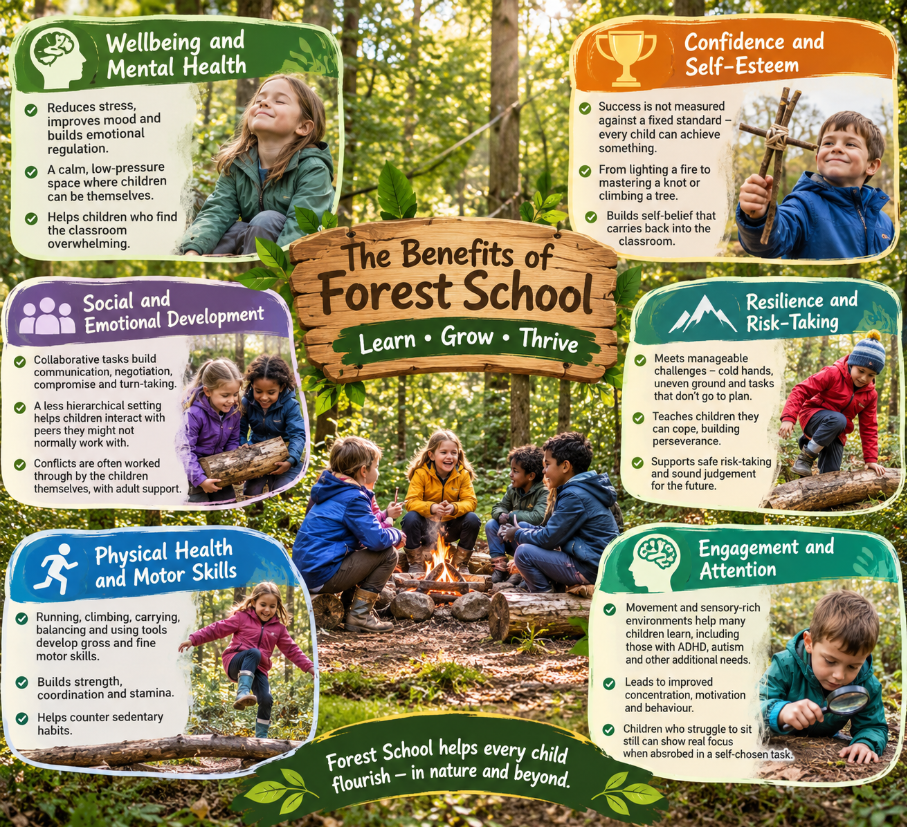
Curriculum links. Although forest school is not designed to deliver the curriculum directly, it supports it naturally:
-
Science: habitats, seasonal change, plants and animals, materials and their properties
-
Maths: measuring, estimating, counting, pattern, shape and symmetry
-
English: speaking and listening, descriptive and creative writing, storytelling and vocabulary
-
Art and design: natural sculpture, printing, weaving and mark-making
-
PSHE and personal development: teamwork, responsibility and decision-making
-
Design and technology: planning, making and evaluating with real tools and materials
